Introduction
There are over nine thousand known methods of communication: most of them follow a typical, simplistic scheme where: a connection is first established, and further conversation occurs through this connection. In such scenarios, the connection can be often thought of as a pipeline, and the conversations being the information and/or data that traverses through it.
The purpose of Connections module is to standardize the above communication scheme: harmonize the look & feel of each connection implementation using templates & base classes, and normalize the model that defines, binds & manages these various connections to Device Objects.
Conception
Following object-oriented programming methodology, each independent connection,
regardless of its protocol (telnet/ssh/HTTP/SNMP) or technology
(CLI/REST/YANG), shall be modelled as a class object, where the
communication to and from this pipe is achieved through interaction with its
class methods.
Subsequently, all connections (eg: class object instances) to the same target
device shall be managed through a dedicated, high-level manager that provides
resource allocation, control & conflict management, and finally, seamless
integration to topology.Device object instances.
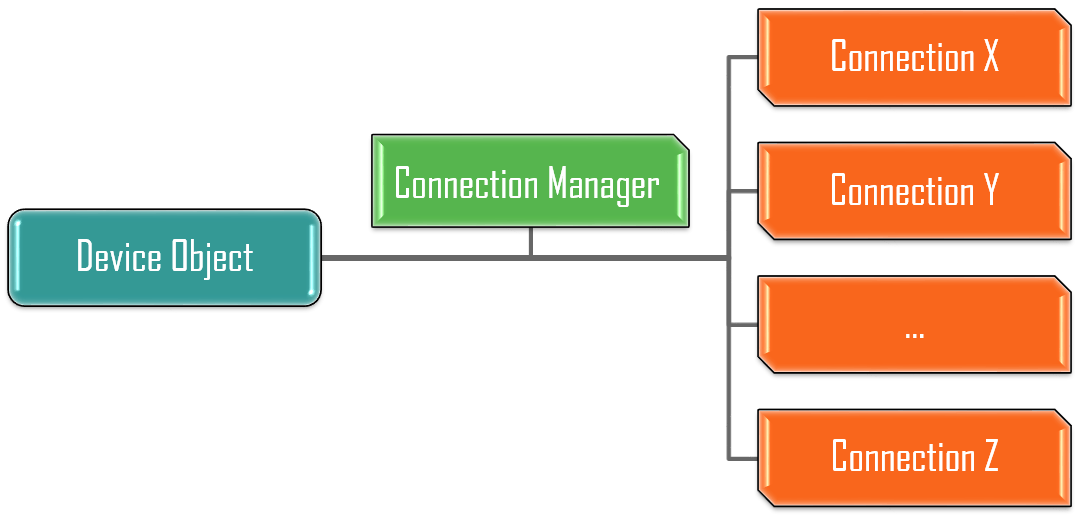
In effect, the connections module is a middleware, providing the basis to how each connection type should be implemented, and interfacing between devices these connection implementations. It features three primary classes:
- ConnectionManager
the behind-the-scene director that binds connections to
topology.Deviceobjects. Eachtopology.Deviceinstance is assigned its ownConnectionManager, which controls all connections to the testbed device this object represents.- BaseConnection
template class, providing the basis for various user imitations & implementations of an actual device connection (eg, telnet to console cli).
- ConnectionPool
connection-like implementation that allows users to create a “pool” of similar-type connections and share them in a multi-processing environment.
These classes are not intended to be invoked from the user script directly - they work behind the scenes, governing script interactions and library implementations.
Installation
Connections module connections is installed by default as part of pyATS
installation. It is also a pre-requisite to installing topology module. This
package is featured on the PyPI server.
Note
connections``module is part of the``pyats namespace, and therefore,
users should always refer to the full namespace when installing & using it.
pip install pyats.connections
To upgrade an existing installation of Connections package in your environment, do:
pip install pyats.connections --upgrade
Note
always read the Changelog first before you upgrade.